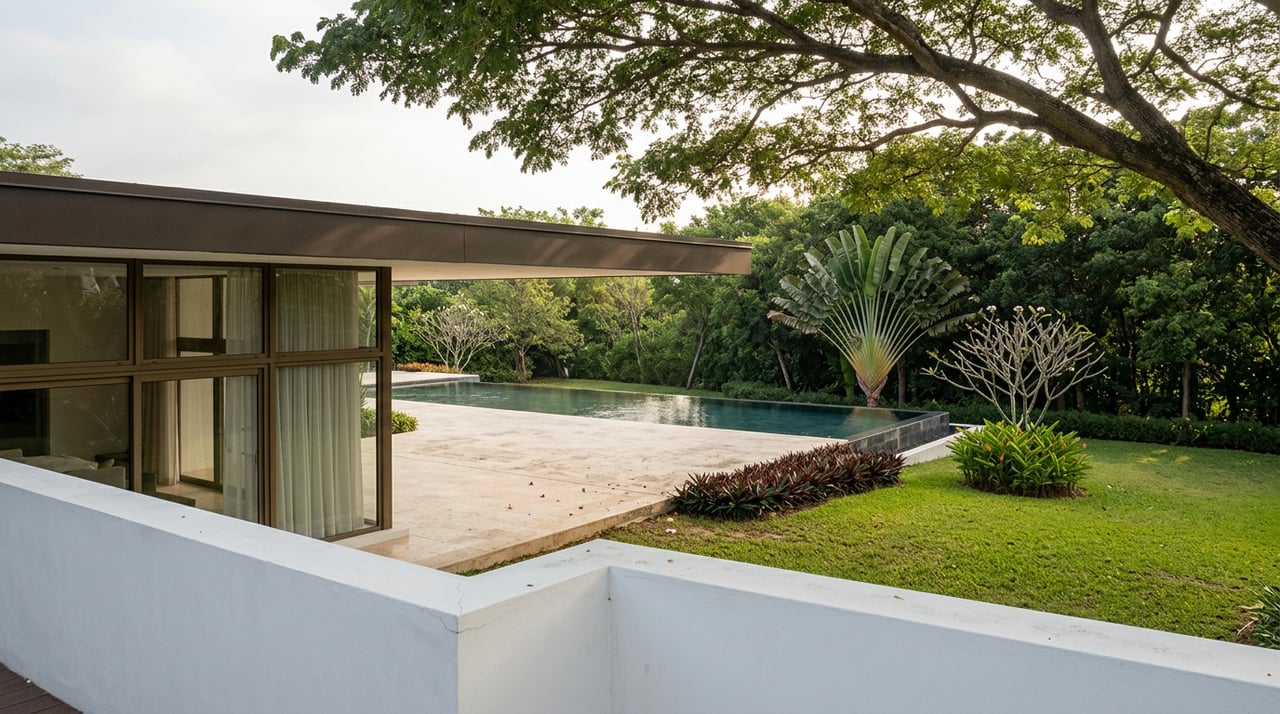
North Shore Home Prices Are Rising. The Bidding Wars Aren't.
Blog September 3, 2026
Blog September 3, 2026
If you have priced a home on Oahu's North Shore this year, you have probably done the math the way most buyers do: prices are climbing by double digits, so competition for that fixed stock of homes must be climbing too. That is the reasonable assumption. It is also the wrong one, and the market's own numbers say so.
For the twelve months ending in July 2026, the median price for a North Shore single-family home rose 13 percent to $1.7 million. Over that same period, the share of North Shore homes that sold above their asking price fell by more than half, down to under 10 percent. A market where prices climb while bidding wars shrink is not describing frenzy. It is describing scarcity, and those are different problems for a buyer to solve.
Set the July 2026 twelve-month snapshot next to the one before it, covering roughly the prior twelve months through late 2025, and the pattern sharpens. Sales volume barely moved, ticking from 78 closed homes to 81. Median price, though, jumped from $1.5 million to $1.7 million in that window, a gain of about $200,000. Days on market actually improved slightly, from 40 down to 35. And the bid-up share, which had already slipped to 16.7 percent in the earlier period, nearly halved again to 9.9 percent.
The number that ties it together is inventory. Active North Shore listings sat at 48 homes in the earlier report and fell to 43 by July 2026. That is not a temporary lull between listing seasons. It is a shelf that keeps getting shorter while the price tag on what remains keeps climbing, largely because what's actually transacting is skewing toward fewer, larger, higher-value homes rather than a broad set of comparable properties trading up in unison.
Set against the rest of the island, the contrast holds up. Oahu-wide, single-family home demand hit a three-year high in July 2026, with sales up 19 percent year over year and the median price rising 12 percent to $1,207,000. The North Shore is not simply riding that broader wave. Its price growth is outpacing the island average even as its own competitive intensity, measured by how often sellers get bid above ask, is falling. That combination only makes sense if the constraint is on the supply side, not the demand side.
Much of the land around Haleiwa and Waialua sits inside Honolulu's agricultural and rural zoning districts, set aside under the city's planning framework to preserve open space, scenic character, and working farmland rather than to host new subdivisions. That is a deliberate policy choice, and it has direct consequences for anyone counting on new construction to loosen up the market.
In December 2024, the Honolulu City Council passed a land use overhaul, Bill 64, that tightened the rules governing agricultural parcels islandwide. Among the changes, at least 51 percent of a farm plot must now be dedicated to actual food production, crop or livestock, for that parcel to keep its agricultural classification. The rule was aimed at closing a loophole that let large, low-density estates masquerade as working farms while enjoying agricultural tax treatment. Whatever its merits for farmland preservation, the practical effect for the housing market is that it becomes harder to treat agricultural acreage as a quiet path to new residential supply. Fewer parcels can convert, and the ones that remain draw more scrutiny before anyone can build.
That structural ceiling on new supply is the mechanism behind the numbers above. When a coast can't easily add inventory, even modest, steady demand shows up as rising prices with thinning competition, because sellers aren't racing each other for buyers so much as buyers are working through a shorter and shorter list of what's actually for sale.
One dispute from last year makes the pattern concrete. As Hawaii News Now reported, developer D.G. Andy Anderson proposed converting a roughly seven-acre parcel, sandwiched between the J.P. Leong Highway and the back of the North Shore Marketplace, from agricultural to urban zoning. The site, at the time nothing more than a gravel road and dry grass, was pitched as infill housing for North Shore workers who currently commute from Waialua or Sunset Beach, an alternative Anderson framed as sparing residents a long daily drive.
The rezoning, Bill 37, needed City Council approval to move forward. In August 2025, the Council chose not to pass it and sent it back to committee. Councilmember Matt Weyer, who represents the North Shore, acknowledged the area's housing need but argued the request had to be weighed against the region's land use rules and whether the site had the infrastructure to support new density. The city's North Shore Sustainable Community Plan, last approved in 2011 and due for a ten-year update, was still being finalized at the time of that vote.
One parcel is not a market. But it is a useful stand-in for what happens every time someone tries to convert North Shore agricultural land into buildable residential supply. The friction Bill 37 ran into is the same friction facing nearly every similar proposal on this coast, and most of those proposals do not clear it. That is the quiet reason the North Shore's active listing count keeps contracting even as buyer interest holds steady.
If you are weighing the North Shore against Kailua, Kahala, or another Oahu neighborhood, the useful reframe is this: you are not looking at a hotter version of those markets, you are looking at a structurally different one, where the ceiling on new housing stock is set by land policy rather than by how many buyers show up in a given season.
That has a few practical implications when you are actually evaluating a specific address. Two homes with nearly identical square footage can carry very different pricing logic depending on whether the underlying parcel is zoned Country, Residential, or Agricultural. Before treating a listing price as directly comparable to something you saw in a conventionally zoned neighborhood elsewhere on the island, it is worth confirming the parcel's actual zoning designation and whether any agricultural dedication is recorded against it, since that dedication can carry its own use restrictions and tax treatment.
It also changes what to expect at the negotiating table. In a genuinely constrained supply pool, sellers have less incentive to chase a price down, even without multiple offers forcing their hand. A falling bid-up percentage on the North Shore does not signal a softening market. It signals that sellers are pricing closer to what they expect a single, patient buyer to pay, rather than counting on an auction to get there.
Does a falling bid-up percentage mean the North Shore is cooling off? Not by the numbers. Price and sales volume both rose over the same period the bid-up share fell. What changed is the mechanism behind the price growth, from competitive bidding toward scarcity-driven pricing, which is a different dynamic to negotiate against, not a weaker one.
Is every North Shore property affected by agricultural zoning? No. Haleiwa's town core, the established residential pockets around Sunset Beach, and other conventionally zoned subdivisions are not subject to the same restrictions. The constraint concentrates in the mauka and inland parcels, particularly around Waialua and the land behind the North Shore Marketplace, which is exactly why confirming a parcel's specific zoning before you fall in love with a listing matters more here than in most other Oahu neighborhoods.
Should I expect this supply picture to change soon? The city's North Shore Sustainable Community Plan update, the document that governs land use decisions like the one Bill 37 ran into, was still being finalized as of the most recent vote on record. Until that update lands, and until any future rezoning request actually clears the Council, the same structural limits that shaped this year's numbers are the ones a buyer should plan around.
Reading a market like the North Shore takes more than watching the median price move. It takes understanding why it's moving, and what that tells you about the specific parcel in front of you. That is the kind of read Drew Read works through with clients on every North Shore property, whether the question is what a listing is actually zoned for or what it should reasonably cost given how few comparable homes have traded this year. If you are sizing up a purchase on this coast, or thinking about what your own North Shore property is worth in a market this thin, Let's Connect.
This article is general information, not legal, tax or financial advice. Consult a qualified professional about your situation.
Stay up to date on the latest real estate trends.
Blog
Market Report
Blog
Whether you are buying your dream island home, selling a property, or expanding your investment portfolio, Drew provides the integrity, expertise, and personal commitment to guide you through every step of your Hawaii real estate journey.